EcoFlow, GoodWe, SAJ, and Pylontech: Four Diverging Storage Routes Reshaping Europe’s Solar Ecosystem (2026)

Put EcoFlow, GoodWe, SAJ, and Pylontech side by side on a project desk right now, and watching where each of them went over the last twenty-four months is genuinely wild.
I’ve worked out of Linker here in Germany since 2020, helping European installers and EPCs engineer, verify, and supply residential and commercial storage systems. Two years ago, ninety percent of partner calls circled around LFP watt-hours and euros per kWh.
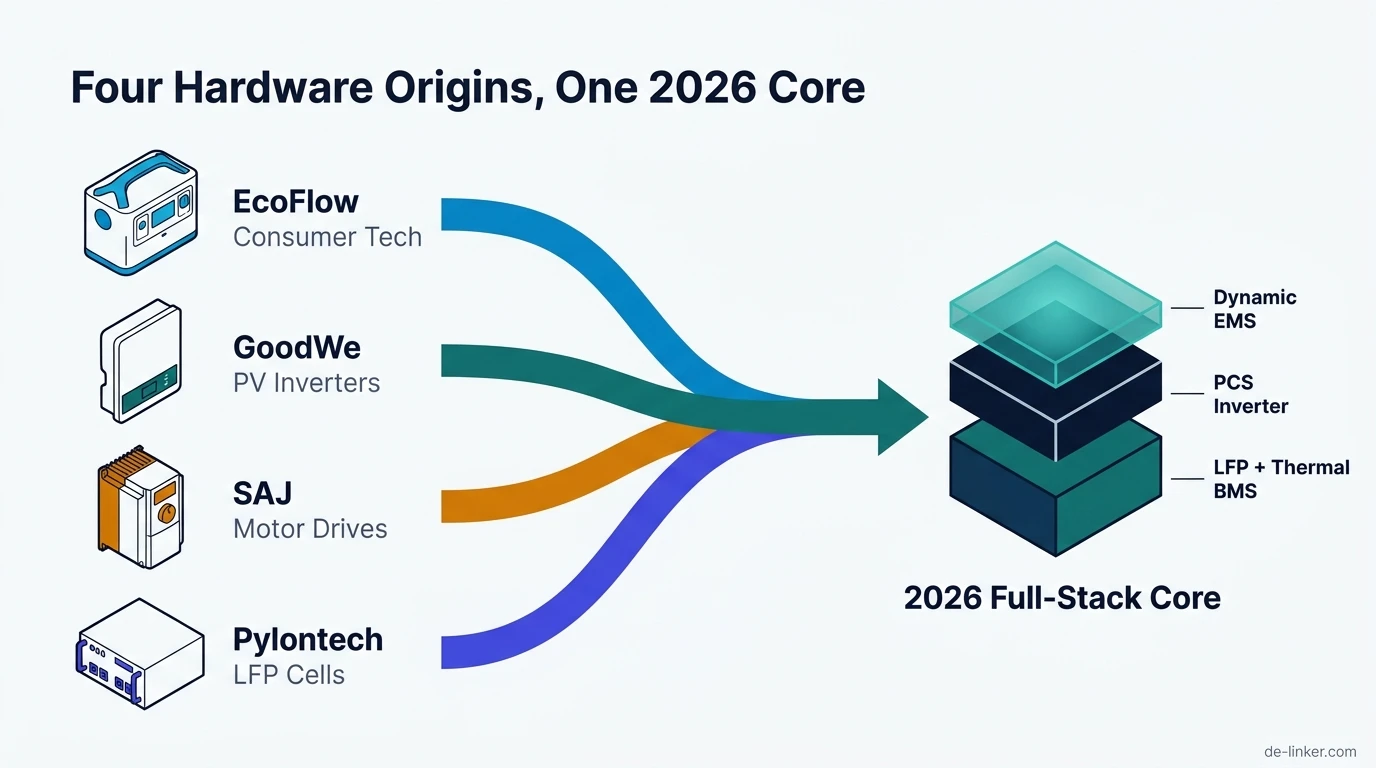
In 2026, the builds crossing our Munich desk come from four completely different types of energy companies:
- EcoFlow: Portable power stations → Three-phase home OS (
PowerOcean,OCEAN 2,OASIS 3.0,EcoBot) - GoodWe: Residential string & hybrid inverters →
5 kW–100 kWplatform (ESA,ETC/BTC + Lynx C,ET + BAT) - SAJ: Industrial motor drives → Pre-matched AI tariff stacks (
HS3,CHS2,1500 V CH3 + CB3) - Pylontech: Open third-party battery bricks → Modular stacks plus PCS-integrated cabinets (
Force H3X,OPTIM US)
Europe added 36 GWh of battery storage in 2025 and passed 100 GWh cumulative capacity[1] (SolarPower Europe), with commercial and multi-revenue assets taking over as the main growth engine. Below is how each route works under the hood—and what their split changes on site for European installers and EPCs.
Four Storage Players, Four Strategic Bets at a Glance
Editorial note: Based on datasheets and dated European compatibility lists on file at Linker, paired with weekly topology sizing and commissioning support across Europe.
| Brand | Two-Year Strategic Shift | Ecosystem Role in Europe Today |
|---|---|---|
| EcoFlow | Portable power → Three-phase home OS (OCEAN 2, OASIS 3.0) |
Consumer-Tech Entrant: Appliance-grade UX, 46 kg self-heating packs, closed residential stack |
| GoodWe | Residential hybrids → 5–100 kW ladder (Lynx C, BAT) |
Full-Range VDE Platform: Munich GmbH base with coherent residential-to-C&I grid paperwork |
| SAJ | Standalone inverters → AI tariff all-in-ones (HS3, CHS2, CH3) |
Tariff-Focused Integrator: Industrial VFD roots tuned for 15-min spot & Nordic frequency markets |
| Pylontech | Open US5000 / Force bricks → Closed PCS cabinets (L260-OMNI) |
Vertical Cell-to-Cabinet Maker: Keeps open retrofit stacks while shipping turnkey all-in-ones |
Beyond €/kWh: Why Four Different Origins Converged on the Full Stack
Europe’s storage market is shifting weight from single-family roofs toward commercial and grid-flexibility assets:
- 2025 Additions:
36 GWhinstalled across Europe (+48% YoY)[2] - Cumulative Milestone: Over
100 GWhoperating fleet - 2026 Trajectory: Projected past
50 GWh, led by C&I and multi-revenue storage
Over that same window, prismatic LFP cycle life and cell pricing settled into a narrow band across tier-one factories. Once bare cells became predictable commodities, all four players moved into full-stack systems to own the software layer and the complete bill of materials.
Three practical forces show up in almost every project brief landing in our Linker inbox:
- Grid-Control Law & Dynamic Tariffs (
§14a EnWG)- Installers still ask us monthly whether ticking “PV-only charging” in the app skips German steerable-load rules.
- Under Bundesnetzagentur ruling
BK6-22-300, any battery>4.2 kWphysically capable of grid charging is regulated by hardware capability (technische Auslegung)—puttingiMSys + Steuerboxand HEMS interfaces straight onto the commissioning checklist.
- Unified PCS and BMS Handshakes
- Housing the hybrid inverter, BMS, and thermal loop under one factory protocol lets OEMs supply the full BOM while sparing electricians from refereeing CAN-bus faults on site.
- Commercial
RLMPeak-Shaving Math (§17 StromNEV)- When an EPC sends Linker a load profile for a bakery, cold store, or metal shop, we check the utility meter first:
≤100,000 kWh/yr(Standard SLP): Billed on volumetric energy (Arbeitspreis) alone.>100,000 kWh/yr(RLMMetering): Adds an annual peak demand fee (Jahresleistungspreis, often63–68+ €/kW·yr) set by the single highest 15-minute spike of the year—where shaving one afternoon peak pays back C&I hardware fast.
| Evaluation Axis | Component-Led Selection (2022–2024) | Full-Stack Ecosystem Selection (2026) |
|---|---|---|
| Primary Buyer Metric | Bare pack €/kWh & nameplate kW |
Installed system cost, crew hours & tariff/peak yield |
| Hardware Pairing | Loose voltage-window matching | Firmware-locked matrices or single-vendor stacks |
| Software & Grid Role | Basic solar self-consumption app | 15-min spot dispatch, FFR/FCR & §14a EnWG control |
| C&I Revenue Logic | Generic daytime solar shifting | RLM 15-minute peak shaving (>100 MWh/yr) & <10 ms UPS |
| Warranty Boundary | Split inverter vs. battery OEM terms | Unified badge or pre-verified two-way compatibility |
Four Routes Up Close: How EcoFlow, GoodWe, SAJ, and Pylontech Diverged
Brochures make every storage system look effortless. Put the wiring diagrams, compatibility PDFs, and IP ratings on the table, and each company’s original DNA jumps right out.
1. EcoFlow: Consumer-Tech Speed Meets Three-Phase Home OS
I’ll be honest: three years ago, I mostly thought of EcoFlow as the brand making slick portable power stations for weekend vans—miles away from the three-phase panels our partners wire in German basements.
Watching their rapid three-step climb changed my mind completely:
① Portable Power Stations → ② PowerOcean & 29.9 kW PowerOcean Plus → ③ 2026 OCEAN 2 + OASIS 3.0 OS
Even though EcoFlow sits outside Linker’s B2B supply lineup, I genuinely respect how hard they pushed the European residential market on app polish and homeowner UX.
- Hardware (
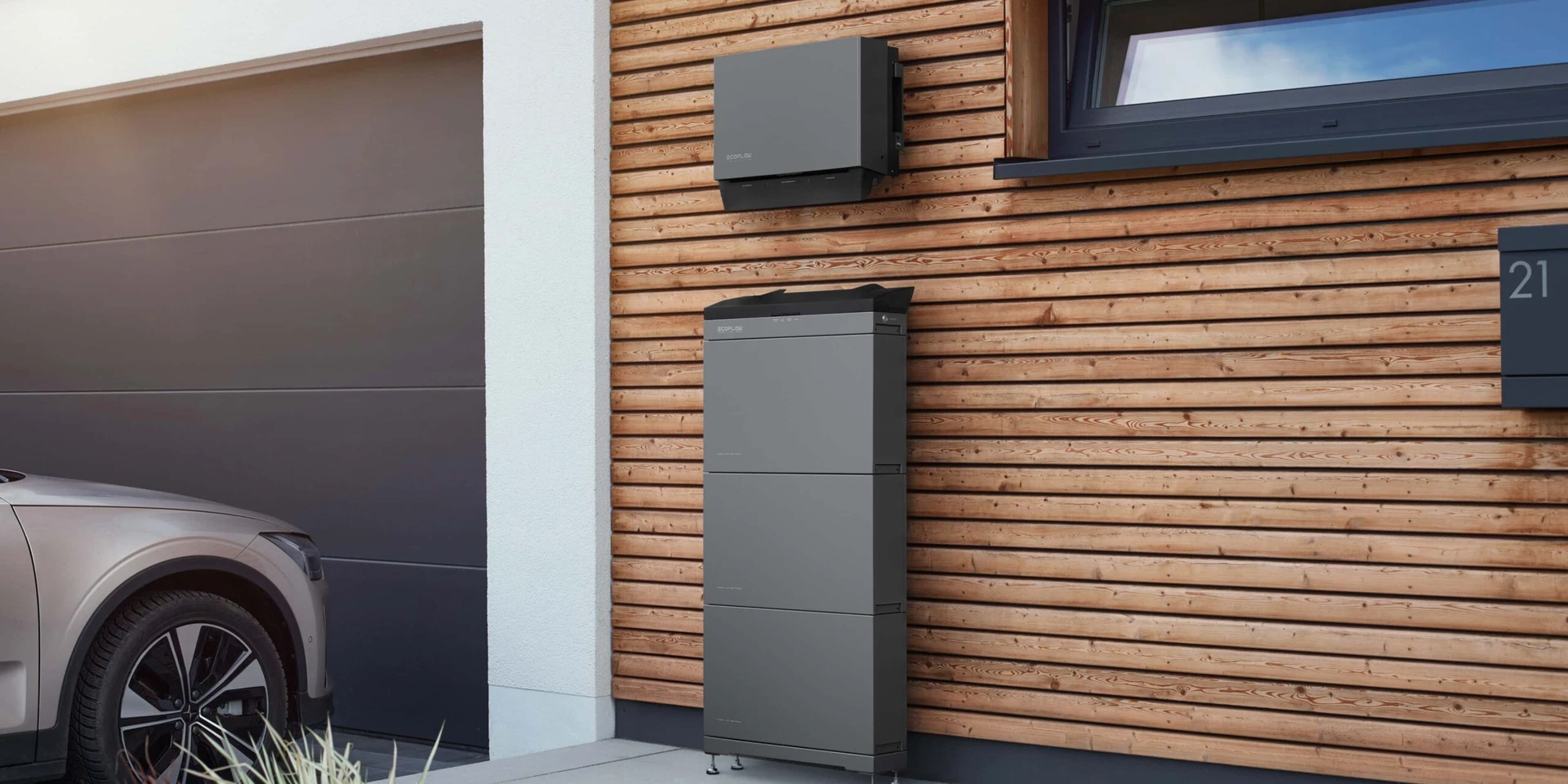
OCEAN 2): Stackable6 / 8 / 10 / 12 kWthree-phase hybrid (3MPPTs,120 Vstart-up,IP66) with46 kg5 kWh(100% DoD) LFP modules—trimmed by9 kg,-20°Cself-heating,10,000cycles,15-yearrating, scalable to60 kWh, and backward-compatible withPowerOcean Pluspacks. - Software (
OASIS 3.0+EcoBot): Connects1,000+European dynamic utility tariffs,Matterappliances, and natural-language scheduling; addedLocal Modeand installer API/Modbus access in late 2026 after early power-user feedback.
EcoFlow Route Verdict
- Where it wins: Fast software iteration, back-saving
46 kgself-heating modules, and slick EV-charging + heat-pump UX. - Best fit: Residential crews serving tech-forward three-phase homeowners who want cable-free stacking.
- Boundaries: Proprietary closed hardware (zero third-party pairing) and residential-only scope below
50–260 kWhC&I cabinets (analyzed here as a market benchmark outside Linker’s supply lineup).
2. GoodWe: Inverter Engineering Scaled to a 5–100 kW VDE Platform
GoodWe is a platform our Linker engineers work with every single day, shaped heavily by their Munich GoodWe Europe GmbH team. They stretched residential ET, BT (AC retrofit), and ESA (5–30 kW) trust into a full 100 kW commercial ladder.
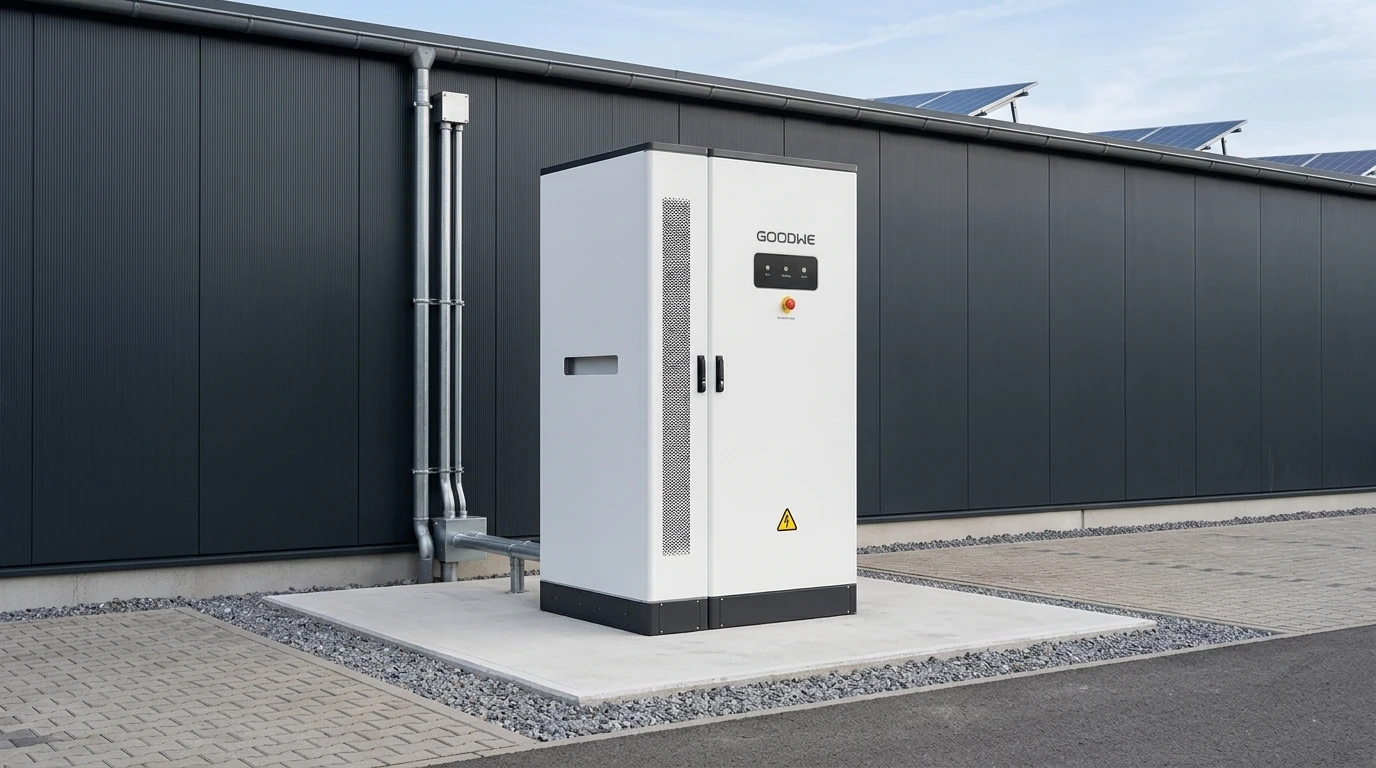
When we engineer GoodWe C&I BOMs at Linker, keeping three separate commercial tracks straight prevents instant site mismatches:
| GoodWe C&I Track | Power & Capacity | Enclosure & Pairing Boundary |
|---|---|---|
Lynx C 60K All-in-One |
ET 15–30 kW · 60–180 kWh |
IP55 / C4 outdoor cabinet with built-in inverter bay |
ETC / BTC + Lynx C Rack |
50–100 kW · 101–156 kWh |
<10 ms UPS switching; exclusively indoor IP21 ground racks |
ET-G10 + BAT Outdoor |
80–100 kW · 112.6–448 kWh |
300–800 V (VDE 4110/4120); air (BAT-AC) or liquid (261.2-LCD) + GW125K-STS |
GoodWe Route Verdict
- Where it wins: Coherent VDE paperwork from
5 kWhomes to100 kW+plants,29.9 kVAthreshold sizing, and dedicatedIP21vs.IP55cabinets. - Best fit: Multi-segment installers and EPCs running one commissioning workflow across rooftops and
RLMpeak-shaving sites. - Boundaries: Strict version discipline—before shipping, we verify separate
ARM,DSP, andEMSfirmware floors on20260910-EMEA-DE-V029.1, pack matchingGM3305A split-core CTs, and flagGoodWe PLUS+/SEMSreporting for 10-year hybrid extensions.
3. SAJ: Industrial Drive Roots Tuned for Compact Tariff Arbitrage
SAJ started in industrial variable-frequency motor drives in 2005 and opened its Frankfurt hub in 2023. Bundling conversion, battery packs, and Elekeeper AI dispatch propelled its DC/DC-optimized HS3 (380–500 V BU3 bus, upgraded from natural-convection 102.4 V HS2 / BU2) into Sweden’s top two residential spots by Q4 2025.
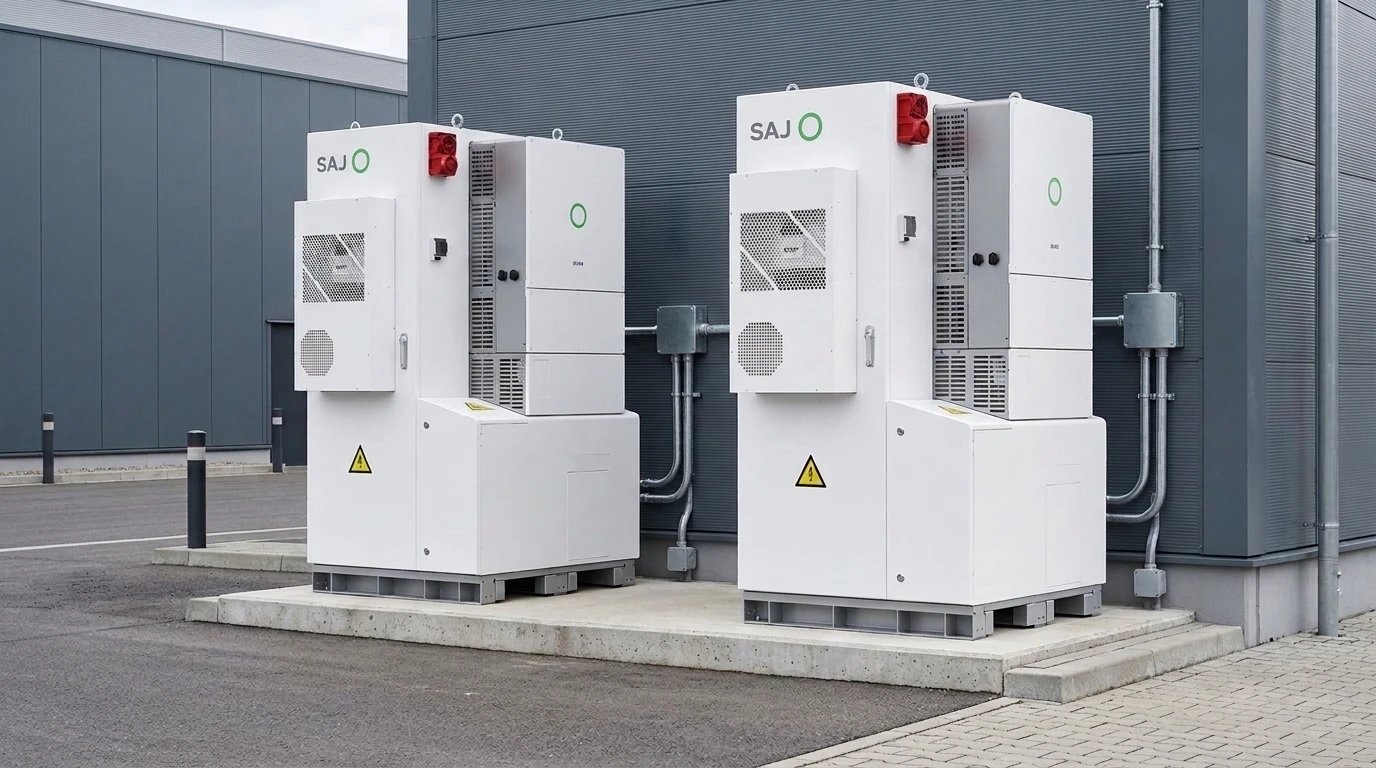
On commercial quotes we scope with contractors, SAJ splits cleanly by cooling architecture and DC bus window:
| SAJ Commercial Line | Inverter & Bus Window | Battery Cooling & Grid Credentials |
|---|---|---|
CHS2 (29.9–50 kW) |
Integrated CH2 (180–800 V) |
57.3–100.3 kWh IP55 industrial air-conditioned cabinet; Nordic CheckWatt FFR/FCR certified |
CH3 (75–125 kW) |
1500 V DC PV · 750–950 V bat (IP66 air-cooled) |
Pairs with outdoor liquid-cooled CB3-L261 (261 kWh, ~2,400 kg ADR) or CM2 cabinet |
SAJ Route Verdict
- Where it wins: Factory-matched single-badge setup, proven Nordic
CheckWattand 15-minute tariff traction, and compact C&I footprints. - Best fit: Contractors prioritizing fast single-vendor installation and automated spot-tariff arbitrage.
- Boundaries: Zero cross-generation mixing (
BU2≠HS3;CH2180–800 V≠CH3750–950 V), native-only C&I batteries, and upfront country VNB certificate checks on newer C&I frames.
4. Pylontech: The Open Battery Workhorse Builds Closed PCS Cabinets
Anyone with a few winters in European storage has a soft spot for Pylontech—US5000 bricks and Force towers (2M+ systems shipped globally) carried Europe’s retrofit market for years. Watching Pylontech add closed, PCS-integrated turnkey cabinets inside the same catalog shows just how fast the value chain is moving.
| Pylontech Track | Core Models | Scope & BOM Responsibility |
|---|---|---|
Track 1: Open Stacks (Komponente) |
48 V US5000 (4.8 kWh, IP20 indoor) · Force H2 / H3 (102.4 V / 5.12 kWh, 2–7 modules to 35.84 kWh, 6 towers to ~215 kWh) |
Battery-only; requires external hybrid inverter, separate FC1000 BMS box, cable kits & IP20 indoor rack |
| Track 2: Closed PCS Turnkey | Residential Force H3X (3.6–15 kW) · C&I OPTIM US L260-OMNI (125 kW / 260–261 kWh liquid-cooled) · Utility Powercube |
Built-in PCS/inverter + BMS + EMS (L260-OMNI adds gas detection & explosion-proof exhaust; zero external inverter ports) |
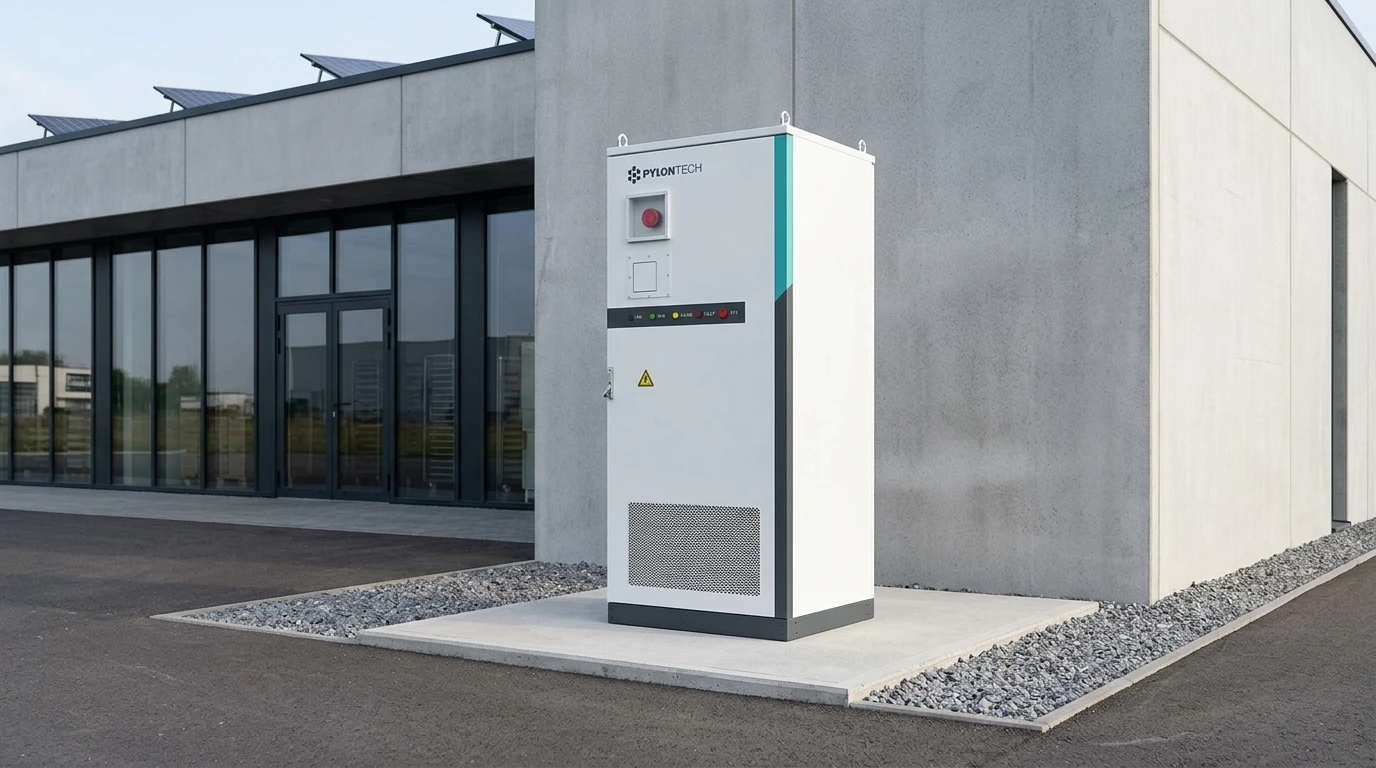
Two Pylontech BOM rules our team double-checks on every quote:
- Minimum module floors: A 2-module
Force H3tower (204.8 V) sits below the mandatory3–7module floor required by several15–30 kWhybrids onVer. 2.43(andForce H3Xcaps output at2.5 kWon a single module). - Model suffixes (
-OMNIvs.-BAT):OPTIM US -OMNI / -HYcabinets house internal PCS converters, whereas the siblingL417-BATis a DC-only battery cabinet with no internal PCS or public inverter whitelist.
Pylontech Route Verdict
- Where it wins: Proven cell-to-BMS cycle history, deep retrofit reach on
US5000 / Force, plus260 kWhliquid-cooled turnkey C&I cabinets. - Best fit: Multi-brand retrofit specialists and EPCs deploying self-contained
125 kW / 260 kWhpeak-shaving units. - Boundaries: Separate
FC1000/IP20rack accessories on component stacks, plus gradually narrowing third-party whitelists as inverter OEMs push native batteries.
How These Four Diverging Routes Reshape Europe’s Solar-Storage Ecosystem
Step back from individual datasheets, and this four-way push into full-stack territory explains the exact friction European installers and EPCs feel in 2026.
1. Loose “Mix-and-Match” Hardware Is Losing Warranty Ground
Few things in this industry frustrate me more than seeing a solid electrical crew trapped in a Schwarzer-Peter-Spiel—two vendors blaming each other’s CAN bus while the homeowner holds the installer accountable.
Look at two current 2026 PDFs we keep on file at Linker:
| Official 2026 Document | Standard GoodWe ET (5–30 kW) Status |
Field Warranty Consequence |
|---|---|---|
Pylontech HV List (Ver. 2.43, May 2026) |
Lists Force H1 / H2 / H3 as compatible |
Battery side appears approved on paper |
GoodWe EMEA Overview (V029.1, Sep 2026) |
Omits Pylontech on standard ET (kept on EH / BT / BH / ET G2 only) |
GoodWe Limited Warranty applies strictly to listed batteries |
Catching that one-way paper split—and running pre-shipment verification before a pallet leaves Munich—is half the reason partners ask Linker to engineer the complete package upfront.

2. EMS Software and Grid Plumbing Create the Real Lock-In
Five years ago, swapping a battery bank mostly meant matching 48 V CAN pinouts. Today, replacing a storage brand years after commissioning means rewiring an entire regulatory chain:

Once a home or factory is signed off around OASIS 3.0, Elekeeper, or GoodWe’s SEMS / SEC controllers, software orchestration and grid-operator metering form the deepest long-term commitment on site.
3. Zweitfahrt Costs Push Installers to Consolidate Lineups
Spend ten minutes on photovoltaikforum—or listening to crews calling our commissioning support desk—and one profit killer dominates: the Zweitfahrt (unpaid second truck roll) over a missing GM330 5A CT, a wrong RJ45-M19 harness, or an ARM / EMS firmware build sitting one step below the battery floor.
Meanwhile, several OEM warranties start counting down 12 months after factory manufacture date on uncommissioned warehouse stock. Smart European contractors are trimming five-brand habits down to two or three complementary ecosystems, backed by a strict pre-dispatch gate:
- Two-way PDF check: Confirm both current European compatibility lists on file include the exact inverter + battery model.
- Module floor check: Verify tower count meets the specific inverter kW minimum (e.g.,
≥3bricks on15–30 kWhybrids). - Firmware alignment: Match
ARM,DSP, andEMSfactory floors before dispatch. - Meter & CT kit: Pack dedicated smart meters (
GM330), 5A split-core CTs, and external STS boxes (GW125K-STS) in shipment one. - Manufacture date audit: Check cell-pack production dates so 12-month warranty clocks remain intact.
Matching the Four Ecosystem Routes to Real European Projects
Clean system selection starts with three site facts: utility meter type, existing PV hardware, and mechanical room access.
| Project or Portfolio Profile | Primary Priority | Best-Fit Route Starting Point | Critical Pre-Order Check |
|---|---|---|---|
| Smart 3-Phase Home New Builds | Homeowner UX, dynamic tariffs, IP66 stacking |
EcoFlow (OCEAN 2 / PowerOcean Plus + OASIS 3.0) |
Dedicated EcoFlow build; zero third-party hybrids or industrial PLCs |
| PV Retrofits & Cellar Upgrades | Keep existing inverters, tight stairs, modular scaling | Pylontech (US5000, Force H2/H3) or GoodWe BT / BTC |
Two-way list check, ≥3 module floor, FC1000 & IP20 rack kits |
| 15-Min Arbitrage & Light C&I | Fast single-badge outdoor install, tariff/FFR dispatch | SAJ (HS3 home or air-conditioned CHS2 C&I) |
Lock bus generation (BU2 vs BU3) & site 30 kVA NA-Schutz sum |
Full-Scope EPC (5 kW–100 kW+ RLM) |
Coherent VDE paperwork, <10 ms UPS, 15-min peak shaving |
GoodWe (ESA to ETC+Lynx C / ET+BAT), SAJ CH3+CB3-L261, Pylontech L260-OMNI |
Confirm >100 MWh/yr RLM meter; split IP21 indoor vs IP55 outdoor; plan 2.4–2.9 t ADR unloading |
Engineering note: Treat this matrix as an initial topology filter; local VNB connection rules, fire spacing, cumulative apparent power (ΣSAmax), and 15-minute load curves govern the final project BOM.
Key Questions on Europe’s Shifting Storage Landscape
Will closed all-in-ones completely replace open inverter-plus-battery stacks in Europe?
Short answerBoth have a long runway—closed all-in-ones lead standard new builds, while open modular stacks anchor retrofits and tight utility rooms.
- Where all-in-ones win: Faster crew commissioning and single-badge warranty accountability on new homes and compact C&I pads.
- Where open stacks stay essential: Existing string-inverter roofs, narrow cellar stairs, and AC-coupled upgrades—which is why Pylontech and GoodWe invest in both tracks.
Why are consumer-tech brands and industrial inverter makers colliding in three-phase homes?
Short answerThree-phase residential storage (10–30 kWh) has become the control hub for household electrification across Europe.
- Once heat pumps,
11–22 kWwallboxes, 15-minute spot tariffs, and§14a EnWGsignals hit the main panel, the hybrid inverter and HEMS coordinate the heaviest loads in the building. - Consumer-tech entrants are building downward into high-voltage power electronics while industrial inverter makers invest upward into AI tariff software.
Should European installers standardize on one full-stack brand or carry complementary routes?
Short answerPairing one full-range primary platform + one specialist complement gives most installation and EPC teams the cleanest operational balance.
- Anchor crews on a
5 kW–100 kWVDE platform for core residential and C&I jobs. - Add either a compact tariff-ready all-in-one or an open retrofit stack so you cover edge cases while keeping firmware floors, CT kits, and spare parts tight.
Choosing Which Ecosystem Bet to Build On
Watching EcoFlow, GoodWe, SAJ, and Pylontech push down four distinct tracks makes me genuinely optimistic about European storage—provided we treat brand selection as an architectural commitment. What goes on the quote shapes your crew’s commissioning hours, VDE and §14a EnWG paperwork, and warranty peace of mind for the next decade.
Turning raw product catalogs into field-ready systems is why we built Linker here in Germany around design, supply, and service under one roof across home storage, commercial storage, and utility-scale storage:
- Design & Verification: System topology sizing and two-way checks against current European compatibility lists on file.
- Matched Supply: Pre-shipment testing plus complete BOMs—matched meters, 5A split-core CTs, transfer switches, and VDE certificates on file.
- Field Service Backing: Direct commissioning support and manufacturer RMA coordination when your crew needs backup.
Pricing an upcoming GoodWe, SAJ, or Pylontech project in Europe? Send over the site’s phase setup, target kW/kWh, and grid tier via our project BOM & Quote request or email me at chester@de-linker.com—happy to sanity-check the topology together and put a clean written net Quote on your desk.
References
Related Systems & Compatibility
- GoodWe GW125/261-ESA-LCN-G10 125 kW
- GoodWe GW29.999K-ETA-G20 29.999 kW
- SAJ CHS2-29.9K-T4-X 29.999 kW
- SAJ H2-30K-T3-DE 29.999 kW
- Pylontech L260-OMNI 125 kW
What could the right storage solution do for your site?
We’ll explore how hybrid or AC-coupled storage could work with your installation, your energy use and the outcome you want to achieve.