“Linker helped us evaluate our customer's load profile and confirmed the battery sizing before we ordered. The VDE-AR-N 4110 documentation was complete, and the local utility approved the connection without delays.”
Commercial & Industrial BESS for Grid Interconnection.
Outdoor commercial cabinets, modular C&I systems, and containerized BESS, backed by complete grid and communication documentation.
Linker delivers multi-brand energy storage solutions across GoodWe, SAJ, Pylontech, and CRRC. We help EPCs and project planners match hardware to site load, verify grid compliance files, and secure direct German B2B supply.
Discuss your project parameters, capacity needs, or grid documentation requirements directly with our team.
- All-in-one outdoor C&I cabinets (Air & Liquid Cooling)
- Containerized BESS for larger infrastructure projects
- Grid certificates, single-line data, and register maps
An engineered BESS package is more than battery cells.
Commercial and utility storage require alignment across PCS architecture, thermal control, grid compliance files, and commercial terms. Here is how Linker supports every project.
BESS ARCHITECTURE // SYSTEM SIZING
Build around a verified electrical architecture.
A commercial storage installation is defined by how the PCS, battery stack, BMS, and control components interact under real operating conditions.
Operating voltage windows, continuous C-rates, peak load limits, and thermal cooling methods all dictate how the system performs on site.
Linker organizes hardware options around your site profile, ensuring all electrical and control interfaces align before equipment ships.
- Sized for commercial load profiles, peak demands, and duty cycles.
- Pre-verified PCS, BMS, and transformer interface matching.
- Air-cooled and liquid-cooled options evaluated by project footprint.
COMPLIANCE FILES // GRID & SCADA
Complete technical documentation beside the hardware.
Interconnection reviews require the exact files. Grid operators and planning authorities need verified certificates and clear interface parameters.
Linker keeps test reports, conformity declarations, and communication protocols organized directly with your equipment package.
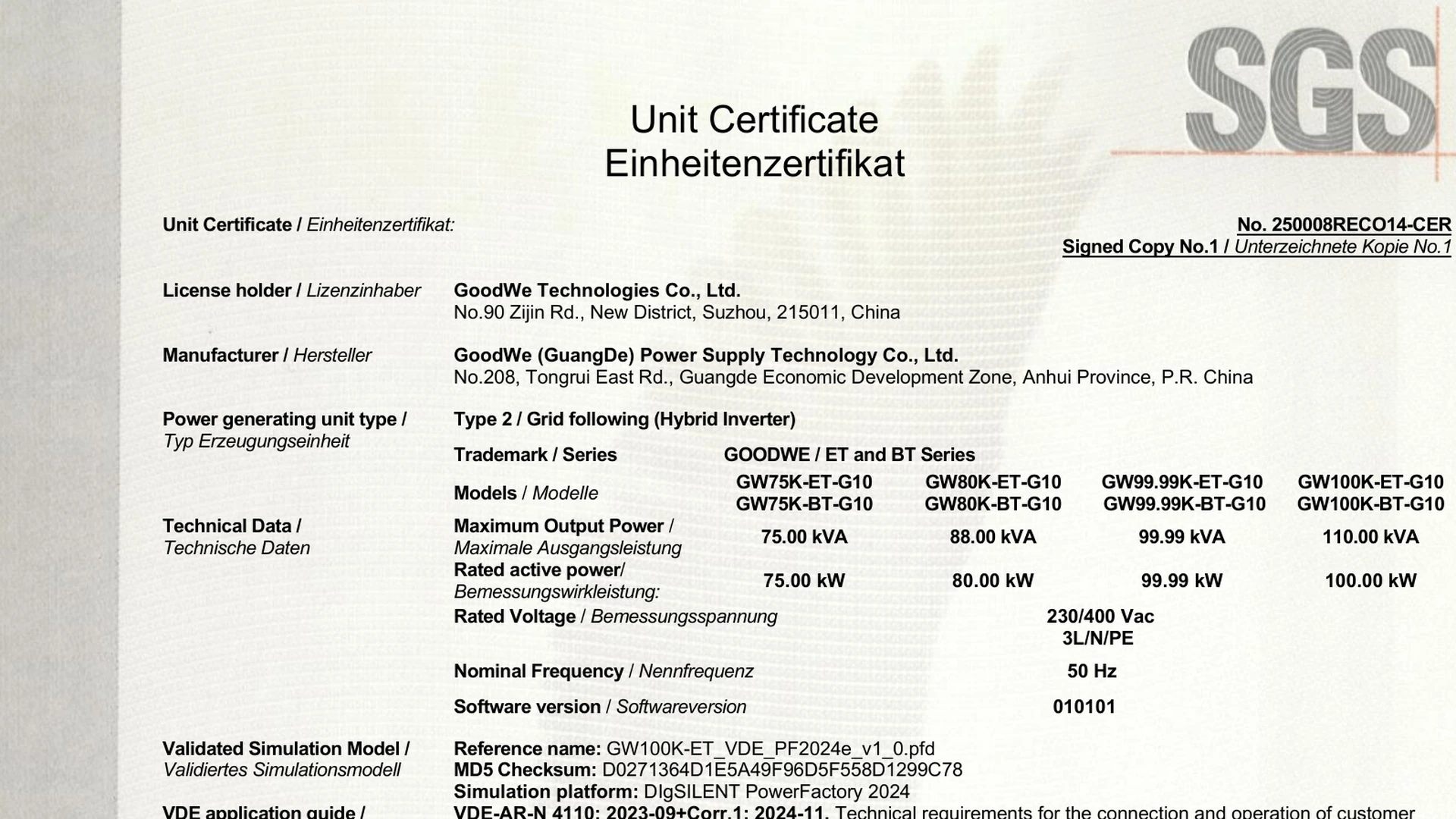
- Unit certificates (VDE-AR-N 4110 / 4120 / Einheitenzertifikate).
- Open Modbus register maps, CAN protocols, and plant-controller interface notes.
- Complete technical datasheets, schematics, and safety compliance files.
B2B EXECUTION // GERMAN OPERATIONS
Commercial clarity from quotation to commissioning.
When your technical specifications are set, Linker manages the commercial procurement route through clear B2B quotations, milestone invoicing, and scheduled transport.
Our German team remains your direct contact for product documentation, technical questions during commissioning, and warranty follow-up.
- Project-specific B2B quotations with clear availability.
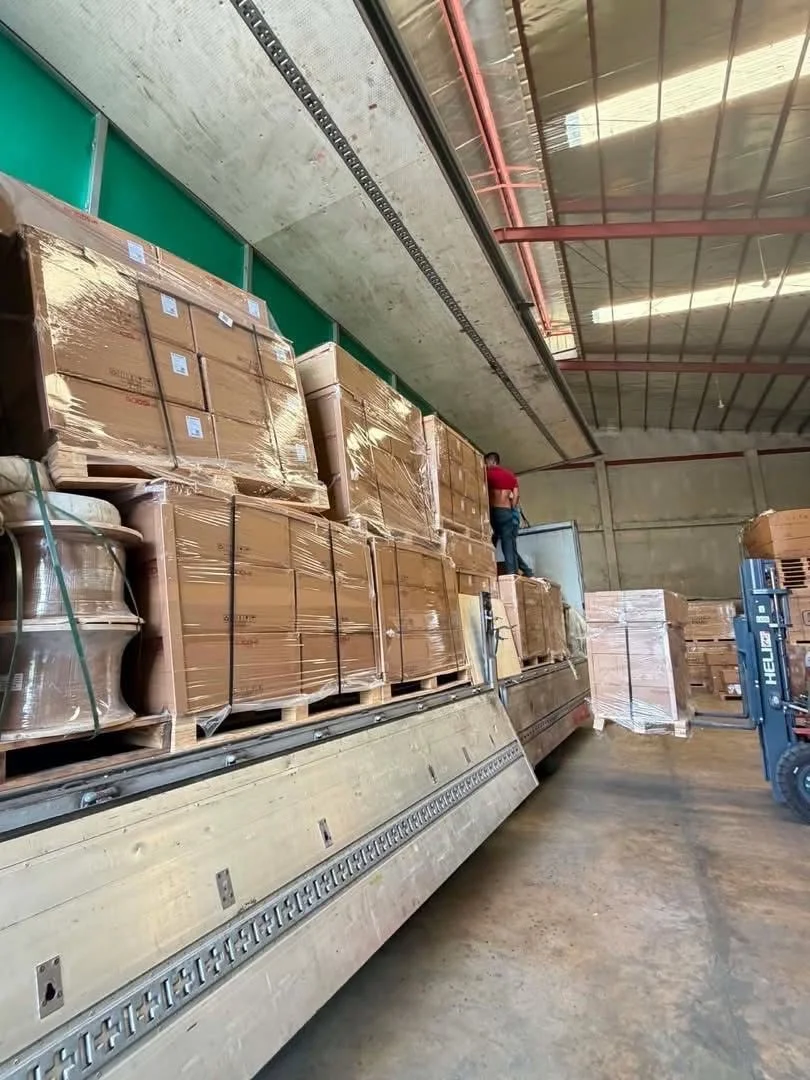
- Coordinated logistics and heavy freight delivery to your schedule.
- Direct warranty coordination backed by original order records.
Two scales. Built for distinct project demands.
Commercial outdoor cabinets and utility container systems share battery chemistry, but differ in footprint, power conversion, thermal architecture, and grid roles.
Outdoor cabinet BESS for commercial & industrial energy projects.
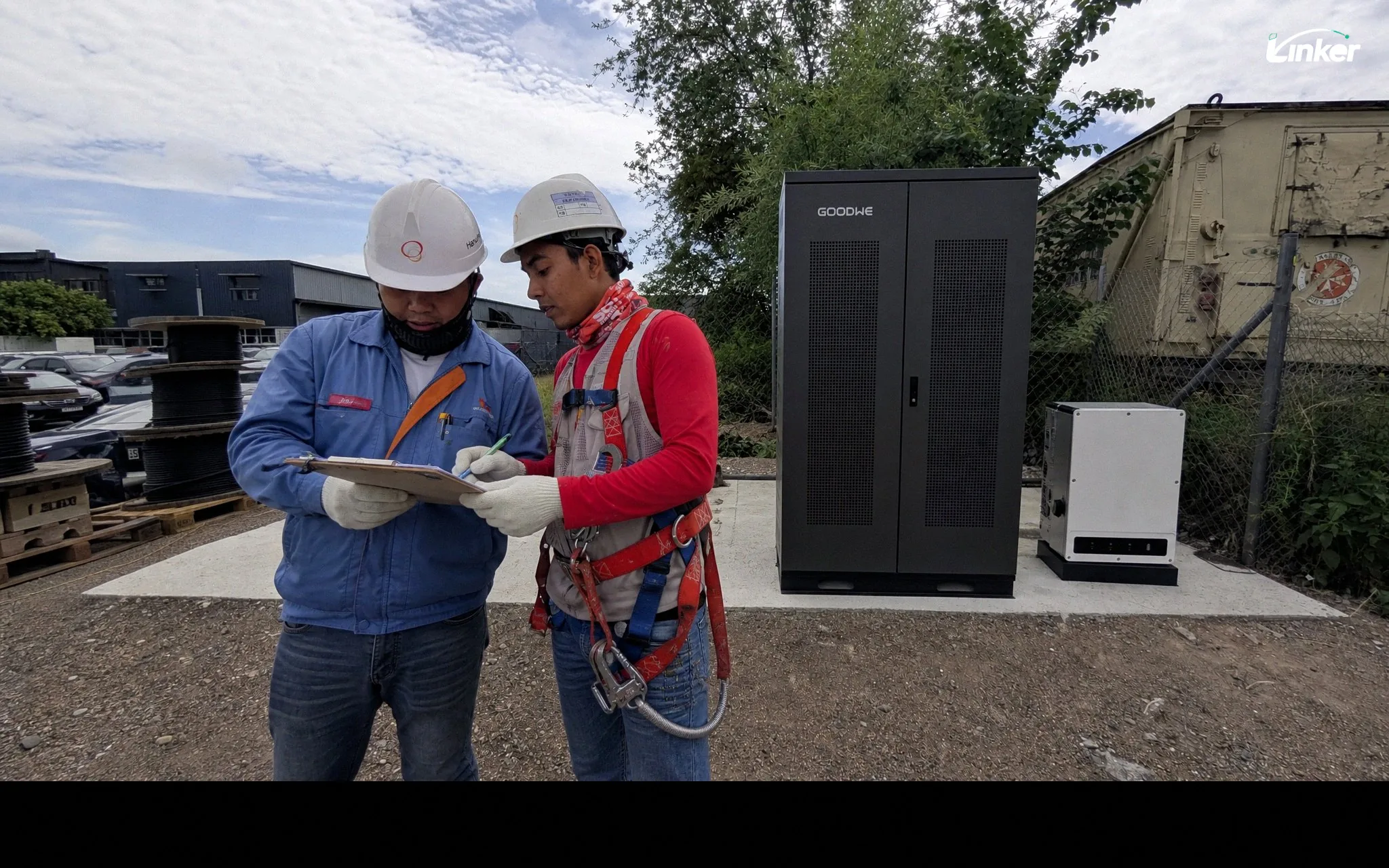
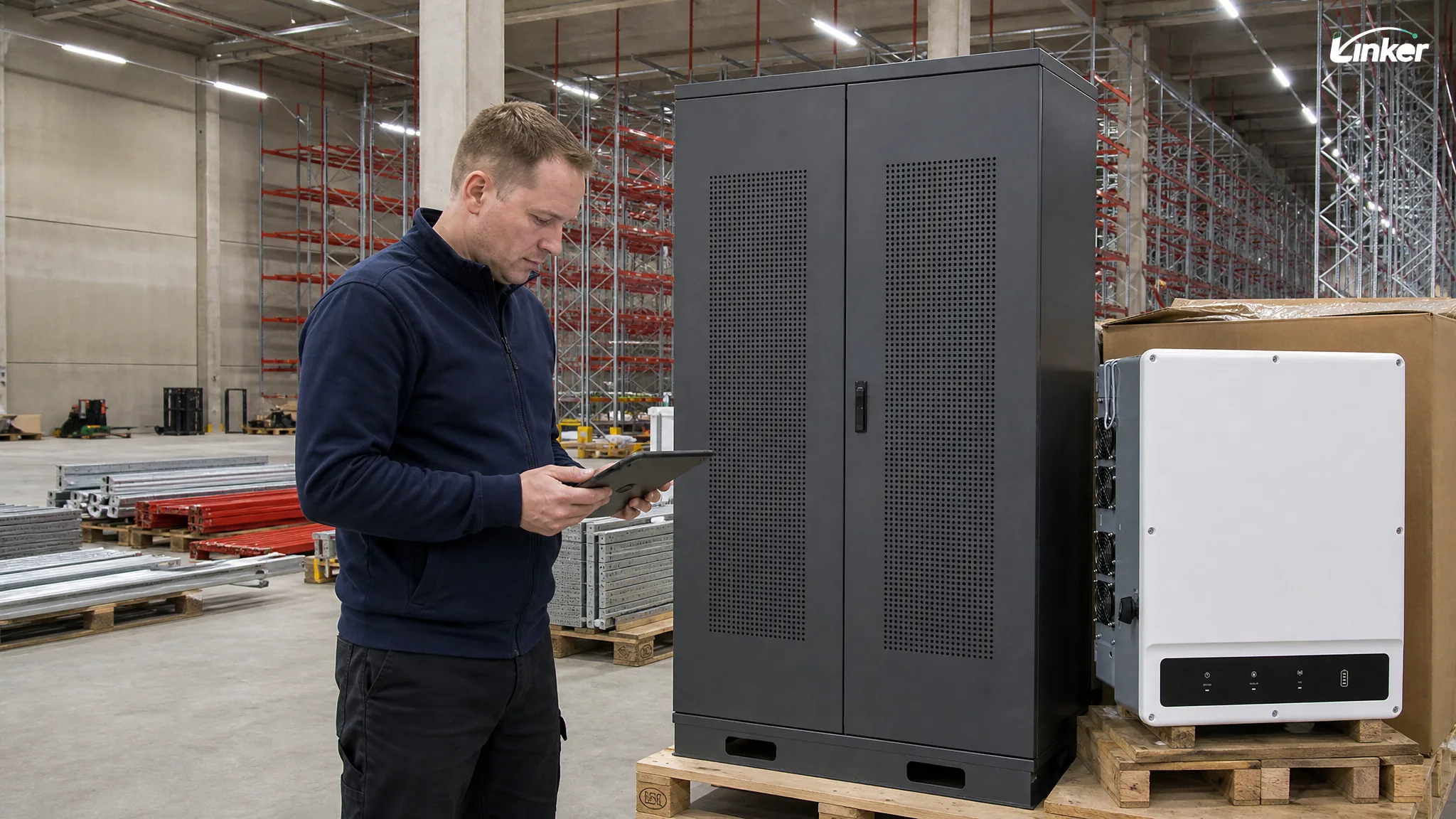
Self-contained outdoor battery cabinets integrating high-voltage battery modules, bi-directional PCS, thermal management (air or liquid cooling), and built-in fire suppression into a compact footprint.
Ideal for manufacturing facilities, logistics centers, agricultural operations, and commercial buildings looking to lower demand charges and increase solar self-consumption.
- Architecture
- All-in-One Outdoor Cabinet (IP54 / IP55)
- Thermal Design
- Smart Air / Liquid Cooling options
- Applications
- Peak Shaving · Commercial PV · EV Charging
- Integration
- Modbus TCP/RTU · External EMS Interface · Smart Metering
Containerized BESS for energy infrastructure & large-scale generation.
High-density containerized storage platforms engineered for multi-megawatt solar farms, microgrids, and utility-scale energy shifting.
Built with high-density liquid-cooled LFP battery racks, multi-tier BMS protection, integrated HVAC chillers, and centralized or string PCS architectures for high round-trip efficiency.
- Architecture
- 20ft / 40ft ISO Containerized BESS
- Capacity Class
- Multi-MWh Scalable Blocks
- Thermal Control
- Industrial Liquid-Cooling Architecture
- Plant Control
- Central SCADA · Frequency Regulation · Substation Integration
Layout data for civil & electrical planning.
- Available cabinet and container dimensional drawings for civil placement.
- Maintenance clearances, door openings, and access zones.
- Dedicated DC/AC cable entry points, conduit routing, and grounding locations.
- Enclosure lifting points, crane rig guidelines, and floor-loading parameters.
Electrical parameters matched to your site load.
- PCS power and battery capacity options matched to site load curves.
- Operating voltage ranges, continuous C-rates, and round-trip efficiency data.
- Ambient operating temperature limits and thermal management performance.
- Lifecycle and capacity retention references.
Technical protocols for seamless SCADA integration.
- Grid certificates (VDE-AR-N 4110 / 4120 medium and high voltage).
- Open Modbus register maps, CAN protocol sheets, and BMS tables.
- Active and reactive power control, ramp rate settings, and droop curve documentation.
- Third-party EMS/SCADA interface notes and communication wiring references.
A structured path from project scope to delivery.
The EPC team manages site engineering and civil execution. Linker supports the equipment side: sizing verification, documentation packs, commercial delivery, and post-sale warranty coordination.
Aligning equipment options with site requirements.
We discuss your project's load profile, transformer capacity, and primary use cases (such as peak shaving or self-consumption) to identify suitable BESS platforms and capacities.
Technical files organized for planning review.
Datasheets, layout drawings, and grid compliance certificates are compiled around the chosen hardware so your engineering team can review them in context.
Structured B2B terms and scheduled delivery.
Selected equipment moves into a formal commercial proposal with clear pricing and delivery milestones through Linker Germany.
Ongoing technical coordination and warranty backing.
Product documentation, communication references, and warranty coordination remain accessible through your dedicated Linker account team.
Real feedback from commercial and grid projects.
Feedback from project engineers, technical planners, and EPC teams working with Linker across commercial storage and larger energy installations.
The questions behind the equipment decision.
At project scale, equipment decisions require clarity on thermal design, control protocols, grid certifications, and warranty structures.
Which BESS brands and platforms are available through Linker?
Linker supplies commercial and utility storage equipment across GoodWe, SAJ, Pylontech, and CRRC.
Solutions range from 50kW outdoor C&I cabinets to multi-MWh containerized systems.
Hardware is selected and configured based on your project's specific C-rate, duty cycle, footprint, and grid-connection requirements.
How should an EPC evaluate different commercial BESS platforms?
Nominal kWh capacity is only one part of the evaluation.
Important factors include usable energy, charge/discharge C-rates, round-trip efficiency (RTE), auxiliary power consumption, thermal architecture (air vs. liquid cooling), and built-in fire safety design.
In addition, grid certification status (such as VDE-AR-N 4110/4120) and open SCADA communication protocols must be confirmed for the exact model.
What technical and grid documentation is available with the equipment?
Every project receives a complete documentation pack based on the selected hardware.
Depending on the platform, documentation typically includes:
- Detailed datasheets and installation manuals.
- Foundation mounting drawings and clearance guidelines.
- Official grid certificates (Unit Certificates / Einheitenzertifikate).
- Modbus register maps, CAN protocol sheets, and BMS communication guides.
- Safety data sheets and test documentation.
What is the difference between air-cooled and liquid-cooled C&I cabinets?
Air cooling is commonly used in smaller C&I cabinets where thermal loads are moderate and mechanical simplicity is prioritized.
Liquid cooling provides higher thermal uniformity across battery cells (delta ≤ 2–3°C), higher energy density, and lower auxiliary power consumption under frequent cycling.
For installations with higher daily throughput or compact space constraints, liquid cooling helps maximize cell lifetime and efficiency.
What differentiates a commercial cabinet from a utility container BESS?
Commercial cabinets are compact, pre-assembled outdoor units (50–250 kW / 100–500 kWh) designed for fast pad installation next to commercial facilities.
Containerized utility systems (20ft/40ft ISO, 2–5 MWh+) are built for high-voltage substations, featuring separate switchgear, external chiller systems, and utility-grade SCADA interfaces.
How does Linker handle post-sale support and warranty coordination?
For all equipment delivered through Linker, our German team remains available for technical references, documentation assistance, and warranty coordination.
If a warranty claim or replacement is needed, Linker helps coordinate the process for you, using your original project records.
Let's discuss your next storage project.
Sizing options, grid compliance documentation, and multi-brand BESS supply through Linker Germany. We are here to answer your questions and explore the right equipment for your project.
- C&I and utility BESS across GoodWe, SAJ, Pylontech, and CRRC
- Project-specific technical, grid, and communication documentation
- Direct German B2B quotation, delivery scheduling, and warranty coordination