Description
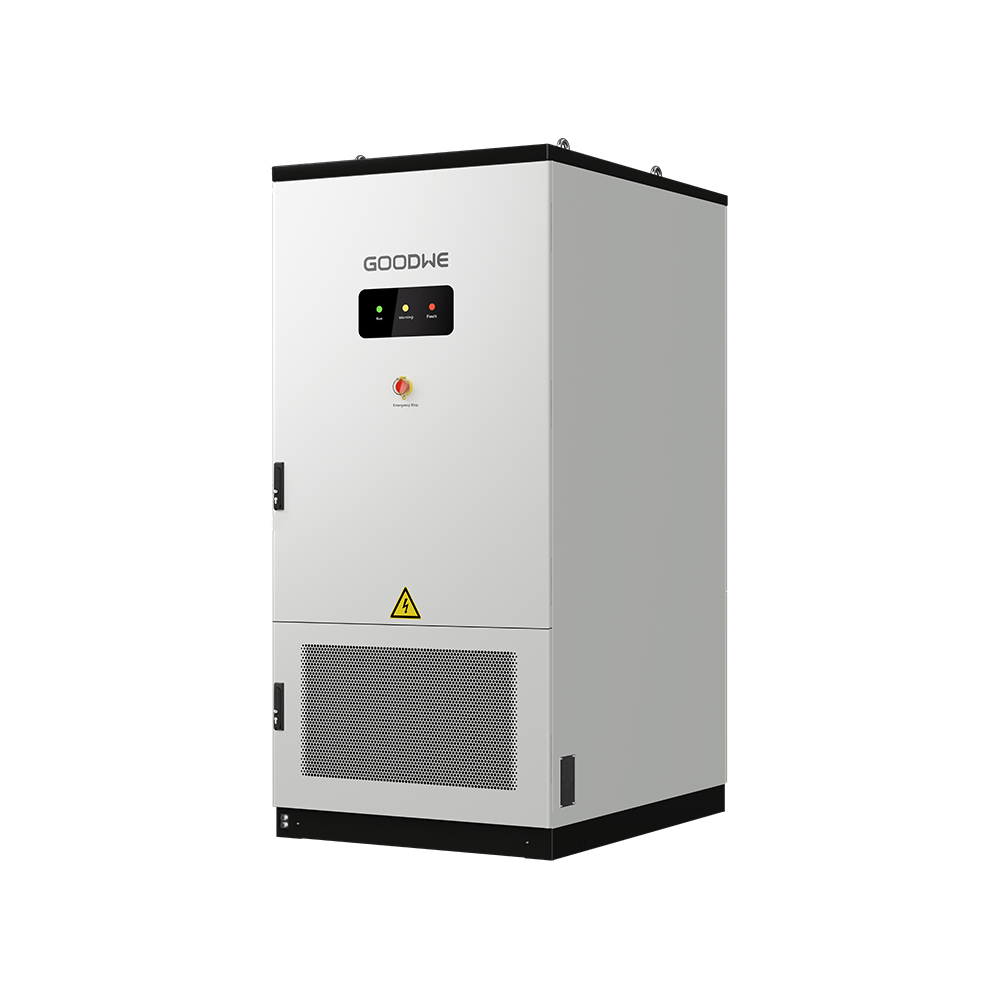
GoodWe ESA GW125/261-ESA-LCN-G10 is a commercial all-in-one storage cabinet: a 125 kW power conversion system, five liquid-cooled LFP battery packs with 261.25 kWh usable energy, battery management and energy management in one IP54 enclosure. It connects on the AC side at 400 V three-phase and runs alongside grid-tied PV inverters. This product is one cabinet; with a SEC3000C controller up to 20 cabinets operate in parallel.
- Rated AC output
- 125 kW
- Usable energy
- 261.25 kWh
- Nominal energy
- 261.25 kWh
- Battery voltage
- 676 – 936 V
- Phases
- 3
GoodWe ESA GW125/261-ESA-LCN-G10 (125 kW / 261 kWh all-in-one storage cabinet)
125 kW / 261.25 kWh in One Cabinet: Power conversion system, five LFP battery packs, battery management and energy management are built in. The cabinet connects on the AC side at 400 V three-phase.
Liquid-Cooled Packs in an IP54 Enclosure: The battery packs are liquid-cooled, the PCS is fan-cooled. Operating range is -25 to +55 °C, with derating from 45 °C.
VDE Grid-Connection Certificates as Downloads: The VDE-AR-N 4105 certificate of conformity and the unit certificate for VDE-AR-N 4110, 4120 and 4130 are available on this page.
Up to 20 Cabinets in Parallel: With a SEC3000C controller, up to 20 cabinets (2.5 MW / 5.22 MWh) operate together with grid-tied PV inverters.
Technical data
Battery
- Cell type
- LFP (LiFePO4)
- Cell capacity
- 314 Ah
- Pack nominal energy
- 52.25 kWh
- Pack configuration
- 1P52S
- Number of packs
- 5
- Nominal energy
- 261.25 kWh
- Usable energy
- 261.25 kWh
- Nominal voltage
- 832 V
- Operating voltage range
- 676 ~ 936 V
- Max. continuous charge / discharge current
- 188 A
- Max. charge / discharge current
- 198.5 A
- Max. charge / discharge rate
- 0.5P
- Depth of discharge
- 90% ~ 100% (90% recommended)
AC connection (on-grid)
- Nominal output power
- 125 kW
- Max. output power
- 137.5 at 400 V AC; 130.6 at 380 V AC kW
- Nominal apparent power
- 125 kVA
- Max. apparent power
- 137.5 at 400 V AC; 130.6 at 380 V AC kVA
- Nominal output voltage
- 400 / 380, 3L / N / PE V
- Output voltage range
- 340 ~ 440 / 323 ~ 418 V
- Nominal grid frequency
- 50 / 60 Hz
- Grid frequency range
- 47.5 ~ 52.5 / 57.5 ~ 62.5 Hz
- Max. AC current
- 198.5 A
- Nominal output current
- 180.4 at 400 V AC; 189.9 at 380 V AC A
- Power factor
- ~1 (0.8 lagging to 0.8 leading)
- Total harmonic distortion
- <3%
- Supported grid types
- TN-S, TN-C, TN-C-S, TT
- IT grids
- No direct connection; possible through an external isolation transformer
- Recommended AC cable cross-section (PE)
- 35 mm²five-core outdoor copper cable
- Recommended AC cable cross-section (L1/L2/L3)
- 70 mm²five-core outdoor copper cable
Off-grid operation
- Nominal output power
- 125 kW
- Max. output power
- 137.5 at 400 V AC; 130.6 at 380 V AC kW
- Switching between grid and off-grid operation
- With a GoodWe STS switching cabinet (separate device, not part of this product)
Efficiency and protection
- Max. PCS efficiency
- 98.6 %
- Max. system efficiency
- 92.0 %
- Battery reverse polarity protection
- Integrated
- Anti-islanding protection
- Integrated
- AC overcurrent protection
- Integrated
- AC short-circuit protection
- Integrated
- AC surge protection
- Type II
- Safety configuration
- Aerosol + water-based fire suppression, explosion-proof fan + explosion-proof plates (optional)
General data
- Operating temperature range
- -25 ~ +55 °C
- Derating temperature
- 45 °C
- Storage temperature
- -20 ~ +45 (one month); 0 ~ +35 (one year) °C
- Relative humidity
- 10% ~ 95%
- Max. operating altitude
- 4000 (2000 derating) m
- Cooling
- Pack: liquid cooling; PCS: smart fan cooling
- User interface
- LED, WLAN + APP
- Communication protocol
- Modbus TCP, Modbus RTU
- Weight
- 2580 kg
- Dimensions (W × H × D)
- 1050 × 2250 × 1400 mm
- Noise emission
- ≤70 dB
- Topology
- Non-isolated
- Ingress protection
- IP54
- Anti-corrosion
- C4 (C5 optional)
- Charge / discharge switching time
- <60 ms
Standards and certificates
- EU declaration of conformity
- LVD 2014/35/EU, EMC 2014/30/EU, RoHS 2011/65/EU and (EU) 2015/863, Regulation (EU) 2023/1542 Articles 10, 12 and 14
- Safety
- EN 62477-1:2012+A11:2014+A1:2017+A12:2021
- EMC
- EN IEC 61000-6-1:2019, EN IEC 61000-6-2:2019, EN IEC 61000-6-3:2021, EN IEC 61000-6-4:2019
- Battery safety
- IEC 62619:2022 (TÜV Rheinland certificate R 50676730 0001)
- Low-voltage grid connection
- VDE-AR-N 4105:2018-11 (TÜV Rheinland certificate of conformity A3 50677141 0001)
- Medium-, high- and extra-high-voltage grid connection
- VDE-AR-N 4110, VDE-AR-N 4120, VDE-AR-N 4130 (SGS unit certificate No. 250008RECO10-CER, valid until 12 December 2030)
- Generating plants on distribution networks
- EN 50549-1:2019+A1, EN 50549-10:2022 (TÜV Rheinland certificate of conformity A3 50714939 0001)
Warranty
- Product warranty
- 5 years (electronics hardware and enclosure)
- Liquid-cooling unit, fire suppression system and lock cylinder
- 2 years; 5 years when the system is connected to SEMS+
- Performance warranty (battery cells)
- 10 years: 70% of the usable energy of 261.25 kWh or 6000 full charge cycles, whichever comes first
- Start of warranty
- First installation, or 6 months after the production date, whichever is earlier
Documents
Product questions
How is the cabinet connected to the grid?
The cabinet supports TN-S, TN-C, TN-C-S, and TT grid types. It does not support direct connection to IT system grids; connection to an IT system grid can be achieved by externally equipping an isolation transformer.
What is needed for power limiting at the grid connection point and for several cabinets?
Current transformers (CTs) and meters must be configured at the grid connection point to enable the grid connection power limitation function. If power outage operations are permitted on-site, install a primary CT at the grid connection point and connect it to the GM330/primary meter. If power outage is not permitted on-site, install a secondary CT on the existing primary CT and connect it to the DTSD1352/secondary meter. When multiple energy storage systems are connected in parallel, insert a terminating resistor into the COM port of the last energy storage system.
Can the cabinet supply the site when the grid fails?
Yes. Off-grid operation is supported. When the grid fails, the PCS controls the switching cabinet to disconnect from the grid and establishes AC voltage. The system switches to off-grid operation, and PV is connected to supply power to loads; the priority for supplying power to loads is PV > Energy Storage. When the grid recovers, the PCS issues a command to close the STS On/Off-grid transfer switch, and the system returns to grid-connected operation.
What does the site need for delivery and installation?
The energy storage system can be transported to the installation site using hoisting or a forklift. When hoisting the equipment, use flexible lifting slings or straps, with a single strap load capacity of ≥5t. When transporting the equipment with a forklift, the forklift's load capacity must be ≥5t. The equipment must be installed on a concrete or other non-combustible surface base. Before installation, ensure the base is level, firm, flat, dry, and has sufficient load-bearing capacity. The base must have pre-embedded conduits or reserved cable outlet holes to facilitate equipment cabling.
Check inverter compatibility
Find an inverter for GW125/261-ESA-LCN-G10 or discuss your existing equipment with our team.
Planning & Commissioning Guides
- ApplicationsC&I Battery Storage Planning: How to Size Peak Shaving, Backup Reserves, and Multi-Unit Scalability Without Conflicting Goals
- Battery StorageIndoor vs. Outdoor Battery Storage: A 4-Step Site Planning Guide to IP Ratings, Thermal Limits, and Fire Codes
- Battery StorageEcoFlow, GoodWe, SAJ, and Pylontech: Four Diverging Storage Routes Reshaping Europe’s Solar Ecosystem (2026)
Related products
-
SAJ CHS2-30K-T4-X
Log in for prices Create account Add to solution draft -
Pylontech OPTIM US L260-OMNI
Log in for prices Create account Add to solution draft -
SAJ CHS2-29.9K-T4-X
Log in for prices Create account Add to solution draft -
SAJ CHS2-50K-T6-X
Log in for prices Create account Add to solution draft